There is a particular kind of panic that walks into our office.
It is not loud. It is not dramatic. It is quiet. Tired. Embarrassed.
And it usually starts with a sentence like this:
“We did everything we were told to do… and now nothing makes sense.”
At Cascade Accounting & Tax, Karen McDonald recently encountered a business owner in exactly that position.
They had tried to do everything “right.” They connected their bank accounts to QuickBooks Online. They integrated PayPal. They linked Stripe. They synced their CRM system. They followed the YouTube tutorials. They hired a freelancer to “set it all up.”
On paper, it looked organised. Modern. Automated.
In reality, it was chaos.
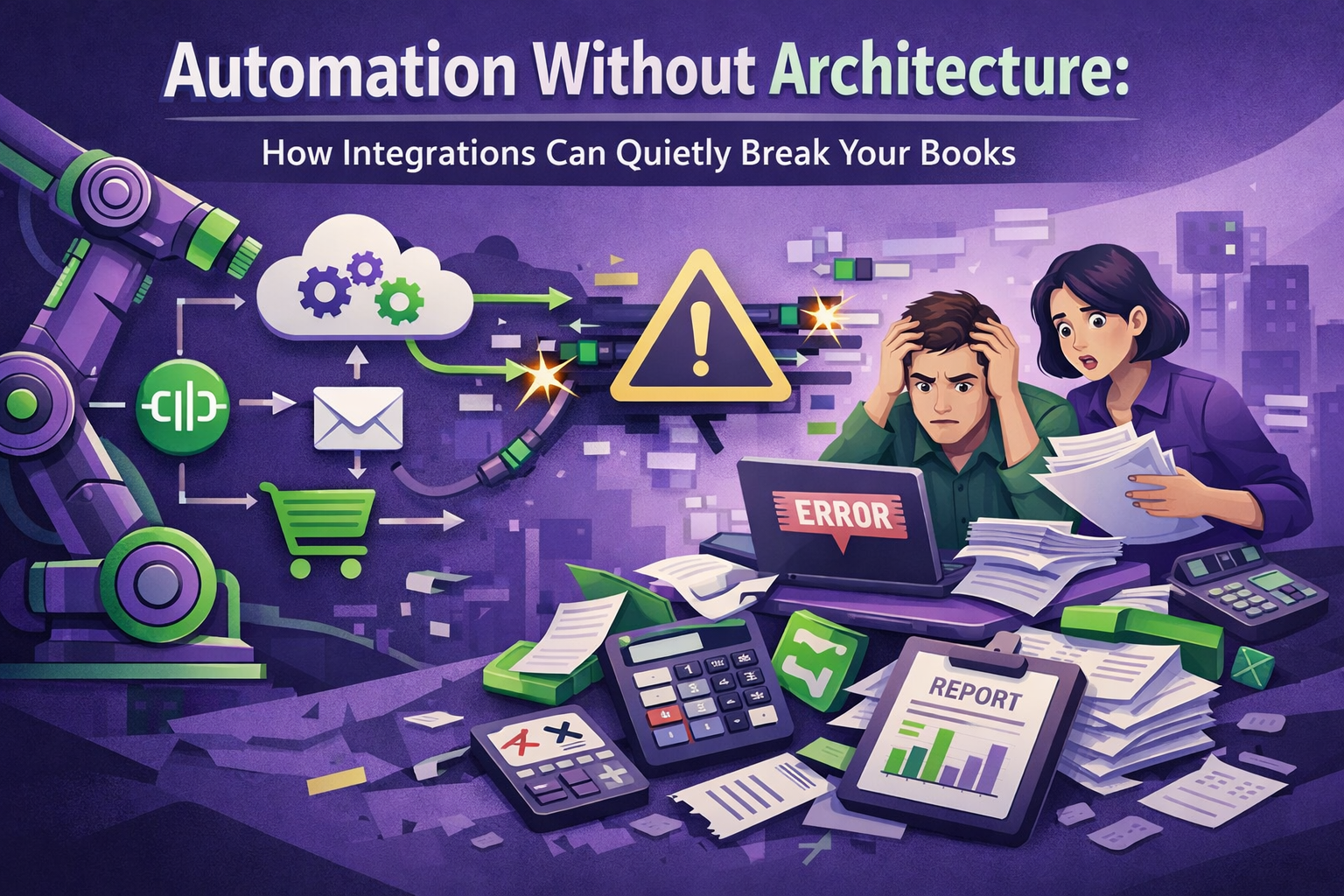
Every System Thought It Was the Boss
Here’s what happened.
Each system was faithfully recording transactions — from its own perspective.
- Stripe recorded the gross sales.
- PayPal recorded the incoming payment.
- The CRM created an invoice.
- The bank feed pulled in the deposit.
- QuickBooks Online imported all of it.
And because no one had designed a clear accounting workflow, the same $10,000 in sales was being recorded two, three, sometimes four times.
Revenue was inflated.
Expenses were duplicated.
Fees were misclassified.
Refunds were recorded inconsistently.
The profit and loss statement looked impressive — until you compared it to the bank balances. 💸
This is what we call “automation without architecture.”
Technology doesn’t create accuracy. It creates speed. If the structure is wrong, you just get wrong numbers faster.
Why This Happens So Often
This situation is not rare. In fact, it’s becoming increasingly common.
Business owners are told to connect everything. Integrate everything. Automate everything.
And integration tools are powerful. But they are not accountants.
QuickBooks Online does not know which system should be the “source of truth.” Stripe does not know how you want fees categorised. Your CRM does not understand revenue recognition rules. And your bank feed does not know the difference between gross income and net deposits.
Without a deliberate accounting design, every system assumes it should report the transaction, and no one is reconciling the logic behind it.
The result?
Beautiful dashboards.
Completely wrong numbers.
The Real Risk Isn’t Just Messy Books
This isn’t just an inconvenience.
When revenue is overstated, you may pay more tax than you owe.
When expenses are duplicated, you distort profitability.
When refunds aren’t handled correctly, your financial statements become unreliable.
When merchant fees aren’t reconciled, your margins are unclear.
And when it comes time for tax filing or an audit, the unraveling begins.
At Cascade Accounting and Tax, we don’t just “clean up books.” We trace the flow of transactions across systems and determine where entries should originate — and where they should not.
In Karen’s recent case, we had to:
- Identify which system would be the primary revenue source
- Undo AI-driven bank reconciliations that simply reconciled transactions created incorrectly
- Remove duplicate imported entries
- Rebuild the chart of accounts to properly separate gross sales, fees, and net deposits
- Re-do reconciliations of all merchant clearing accounts
- Reconstruct accurate financial statements
It wasn’t a bookkeeping tweak. It was a financial reconstruction.
The Illusion of Being “Set Up Correctly”
The business owner genuinely believed they were compliant and organised. They had connected everything. They had reports. They had dashboards.
But no one had stepped back to design the accounting logic behind the integrations.
That is the missing piece.
Accounting is not about plugging systems together. It is about designing the flow of financial truth.
Every dollar must have:
- One point of origin
- One correct classification
- One reconciliation path
Not four.
What We Want Business Owners to Understand
If you are integrating:
- QuickBooks Online
- Stripe
- PayPal
- A CRM
- A scheduling system
- E-commerce software
You absolutely need a deliberate accounting structure.
Ask yourself:
- Which system is creating the sale?
- Which system is collecting the cash?
- Where are merchant fees being recorded?
- Are deposits net or gross?
- Is revenue being duplicated across feeds?
- Are clearing accounts being reconciled monthly?
If you cannot answer those questions clearly, there is a strong possibility your books are overstated, understated, or simply inaccurate.
Technology is a tool. It is not a substitute for tax expertise.
The Cascade Approach
At Cascade Accounting and Tax, our work goes beyond compliance. We look at how your financial systems are structured and ensure they reflect economic reality.
We do not assume automation equals accuracy.
We map the transaction flow.
We test reconciliation paths.
We verify merchant fee treatment.
We correct duplication.
We rebuild financial statements when necessary.
And most importantly, we give business owners confidence that their numbers are real.
Because strategy decisions — hiring, pricing, investing, expansion — depend on trustworthy data.
Final Thought
Doing the “right” things technically does not always mean doing them correctly structurally.
Integrations are powerful. But without accounting design, they can quietly create significant distortion.
If your revenue seems unusually high.
If your bank balance never matches your P&L.
If tax season feels confusing despite having “everything connected.”
It may not be you.
It may be your integrations.
And that is fixable.